The “Zero-Click” Era is Here: Why Your Multilingual Traffic is Disappearing
 MultiLipi
•
Jan. 6, 2026
•
15 minutos de leitura
MultiLipi
•
Jan. 6, 2026
•
15 minutos de leitura
Introduction: The Traffic Vanishing Act in the Age of AI
Imagine waking up to your analytics and seeing a steady decline in organic traffic across all your language sites. It’s not that your rankings tanked or your SEO multilíngue strategy suddenly fell apart – people are simply not clicking through like they used to. Welcome to the “zero-click” era, where searchers get their answers sem ever visiting your website. Globally, more than half of searches now end without any click to an external site[1]. If you’re a CMO, SEO manager, or founder, this trend triggers constructive anxiety: Is our hard-won traffic being siphoned away by AI chatbots and answer engines? For every 1,000 Google searches in the U.S., only 360 clicks go to the open web[Onely]. The rest never reach any external website.
This post will unpack why your multilingual traffic is disappearing and how the shift from traditional search engines to AI-powered answer engines (like ChatGPT and Google’s upcoming Gemini) is fundamentally changing the game. More importantly, we’ll move from anxiety to action, exploring how Generative Engine Optimization (GEO) essentially SEO for AI answers can help you regain visibility. By the end, you’ll have a clear roadmap to adapt your multilingual content strategy for an AI-driven, zero-click world, and a confident plan to turn this disruption into an opportunity. [Localization hidden cost]
From Search Engines to Answer Engines: A Paradigm Shift
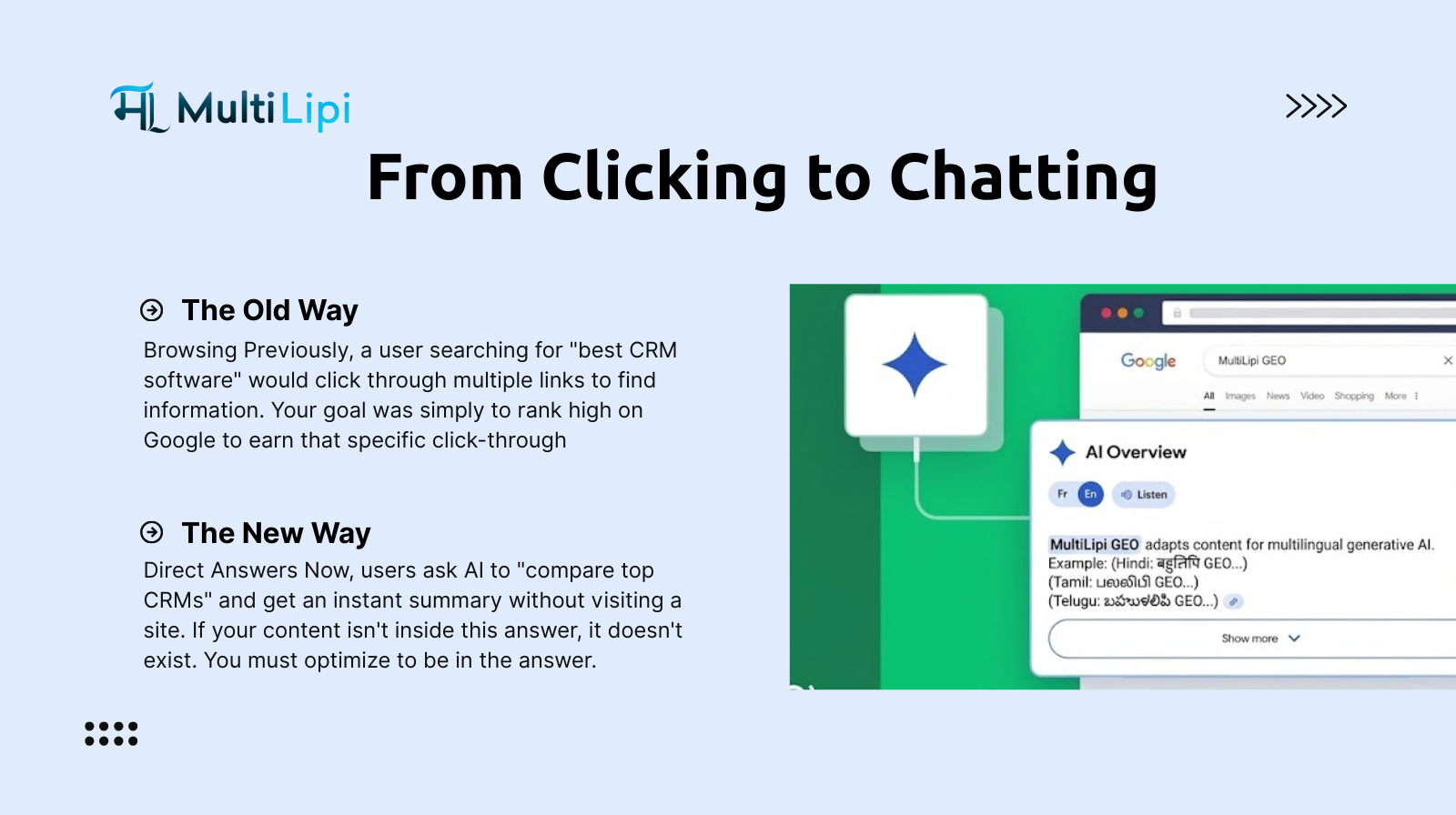
Just a few years ago, search engines like Google acted as portals to discover websites. Users typed queries and got a list of links, and your goal was to rank high and earn that click. Now, increasingly, answer engines are handling those queries. These AI-driven platforms (think ChatGPT, Bing Chat, Google’s SGE, and soon Google Gemini) deliver direct answers to users – often without any additional clicks.
Consider how user behavior is changing. Someone might have searched “best CRM software” and clicked through multiple results. Today, that user is more likely to ask ChatGPT “Can you compare the top 3 CRM software for me?”O AI will generate a comparison on the spot, pulling information from its knowledge without necessarily sending the user to any particular website. In other words, people aren’t browsing the web for answers – they’re chatting with an engine that already reads the web.
Why this matters for you: If your content isn’t part of the answers that these engines provide, it doesn’t exist to that audience. Being on page one of Google isn’t enough if the user never sees the page – you need to be inside the answer. This shift is driving the rise of what we call zero-click searches, where the search results page or chat interface itself satisfies the query.
The Data: Zero-Click Searches Are Soaring, Clicks Are Plummeting
To understand the scope of the problem, let’s look at the data. The decline in organic clicks and the surge in zero-click activity are well documented:
- Organic clicks are at all-time lows: Only 40.3% of Google searches in the U.S. resulted in an organic click as of March 2025, down from 44.2% a year earlier[Search Engine lanf]. In Europe, the pattern is similar – organic CTR fell to 43.5% from 47.1%. This means over half of searches no longer send users to any website via organic results.
- Zero-click searches dominate: By mid-2025, 65% of all Google searches ended without a click. Even Google’s own data for earlier in 2025 showed zero-click queries rising to about 27% on desktop (U.S.), up from 24% the year prior. The discrepancy is because many “clicks” stay within Google’s ecosystem (Maps, YouTube, etc.), not to external sites – the net effect is the same: fewer visitors for you. Notably, zero-click rates are much higher on mobile (77%!) than desktop (47%), since mobile users often get instant answers or call businesses directly from search.
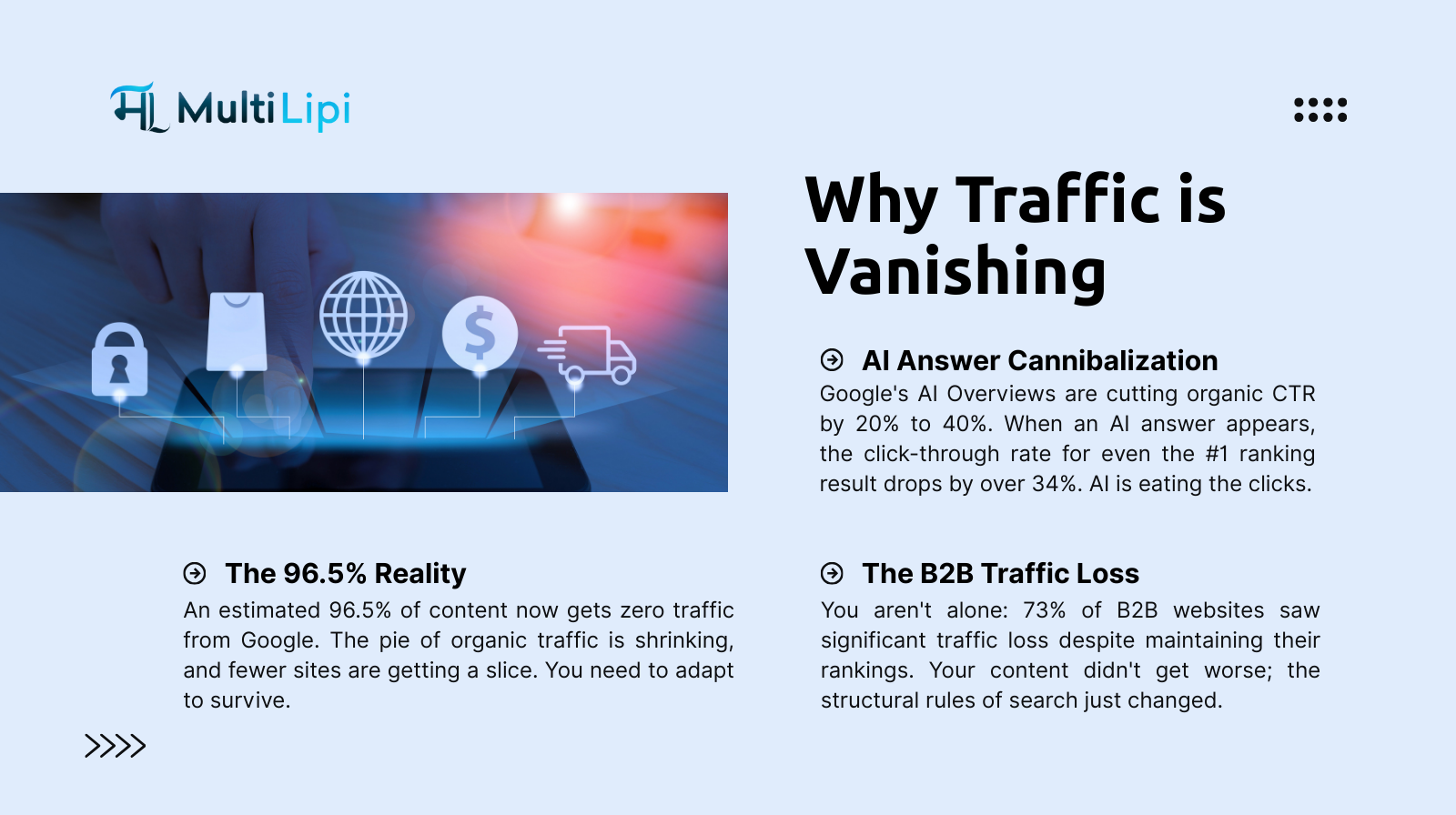
- AI answers cannibalize clicks: Google’s new AI Overviews in search (part of its Search Generative Experience) have a dramatic impact. When these AI-generated answers appear, organic click-through rates drop by 20% to 40% on that query. One study of 10,000 informational keywords found that when AI answers were present, the organic CTR was cut in half (from 1.41% to 0.64% on average). Even the #1 ranking result gets far fewer clicks – one analysis showed a 34.5% decline in clicks to the top result when an AI answer is shown.[Break the Web]
- “It’s not just you”: If you think your traffic drop is unique, think again. 73% of B2B websites experienced significant organic traffic loss between 2024 and 2025 despite maintaining their Google rankings. The content didn’t suddenly get worse – the rules of the game changed. Google’s own evolution and AI competition have structurally shifted where users engage. And shockingly, an estimated 96.5% of content now gets zero traffic from Google – a tiny fraction of pages soak up almost all search clicks.
In short, the pie of organic traffic is shrinking, and fewer sites are getting a slice. This is the “constructive anxiety” part – recognizing that what used to work (traditional SEO targeting blue links) is yielding diminishing returns. But anxiety without action is not productive. So let’s move to understanding why this is happening, especially to multilingual content, and what you can do about it.
Why Your Multilingual Traffic Is Disappearing
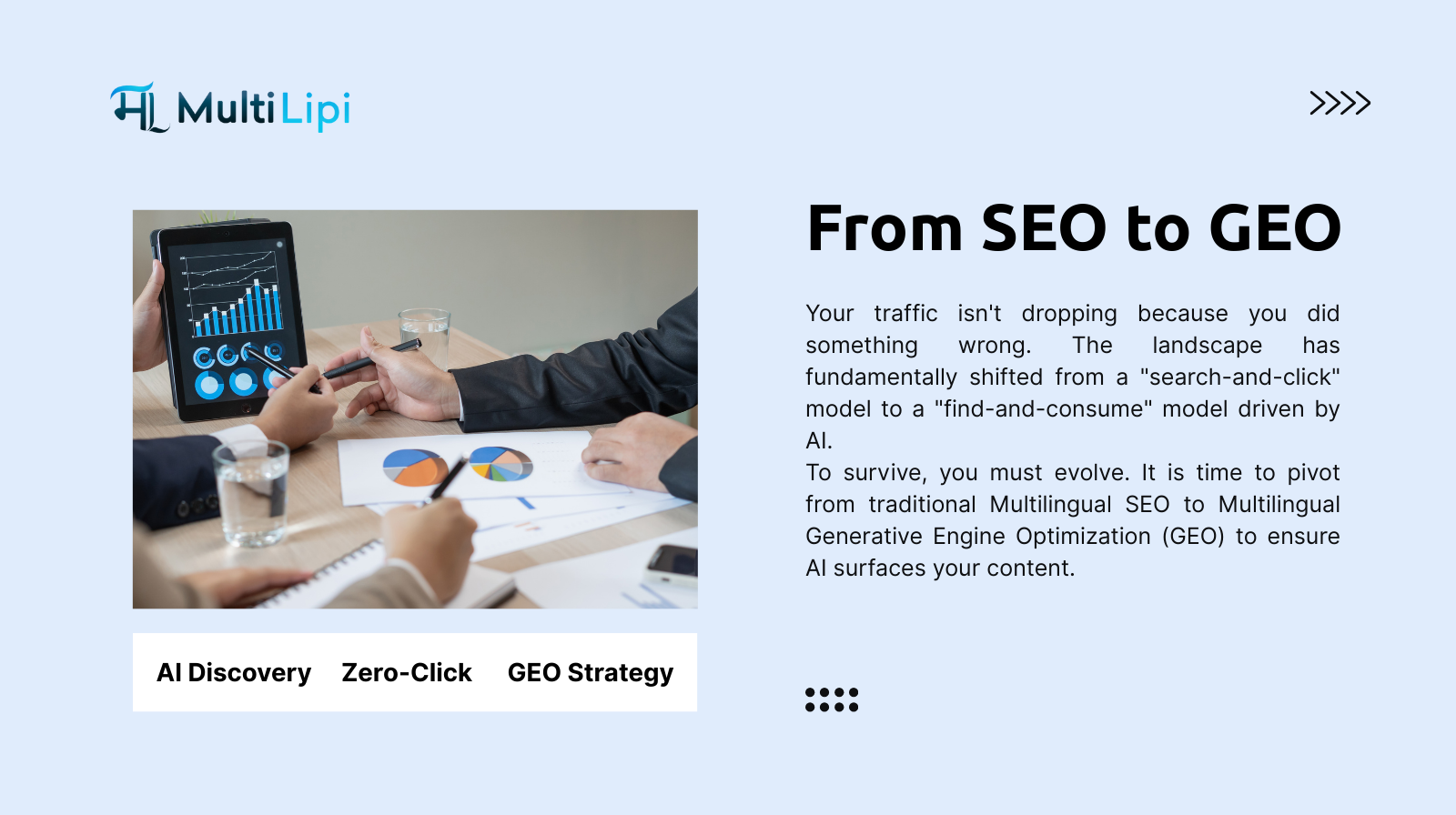
It’s clear that overall organic traffic is under pressure from zero-click and AI answers. For multilingual websites, these challenges are compounded by a unique set of issues – what we might call the multilingual gap in the AI era. Here’s why your translated and localized pages might be particularly at risk:
- AI answers transcend language barriers: Advanced search AI (like Google’s MUM and other LLMs) can understand and translate information across languages. Google’s Multitask Unified Model, for instance, can leverage content in one language to answer a query in another[MultiLipi - Guide to Multilingual SEO]. That means if you have the best article about “how to invest in real estate” in Spanish, an English AI answer could pull those insights sem sending the Spanish user to your site – the AI might translate and summarize it for the user. Even standalone AI like ChatGPT was trained on multiple languages and can respond in, say, French by using knowledge from content originally written in English (and vice versa). The result: your localized page might never get the click or credit for answering the question it was built for.
- Translation vs. optimization for machines: Many companies treat multilingual SEO as simply “translate our English content into X languages.” Traditional translation tools or plugins focus on making the text human-readable, but they often neglect the data and signals that machines rely on. Did your translation process also translate your meta tags, alt text, and JSON-LD schema markup? Did it maintain the proper HTML structure and Etiquetas Hreflang ? If not, search engines may not index or rank your translated pages effectively for their target locales. (For a deep dive on getting hreflang right, see our [LINK: Ultimate Hreflang Tag Guide] which explains how this tag is the “multilingual GPS” for search engines to serve the right language page to the right audience.) If your site’s multilingual framework is weak, Google might simply show an English result or an automatically translated snippet instead of your carefully localized page – another lost click. [Hybrid translation cost]
- LLMs favor authoritative sources (and language plays a role): Large language models have been trained on vast swaths of the internet, but not all languages are equally represented. For example, ChatGPT supports 95+ languages but is most proficient in English due to the larger training data, with accuracy dropping in less common languages[chatbase]. This means if you have content in a niche language, the AI might not “know” it well enough to use it. Conversely, if you translated content into, say, Spanish, but the AI has plenty of English sources it trusts on that topic, it might default to those and just present the answer in Spanish. Unless your multilingual content has built up authority signals (backlinks, mentions, etc.) comparable to top English sources, the AI may ignore it. The painful truth: if your Spanish pagee your competitor’s English page both answer a Spanish user’s query, an AI might pull from the English source that it deems more authoritative, then translate the answer for the user – cutting you out of the equation entirely.
- User trust and behavior in local SERPs: Even outside of pure AI chat, Google’s own behavior indicates it will do whatever provides the fastest answer. For instance, featured snippets and Knowledge Panels often show up for local-language queries, meaning a user in Brazil might get an instant answer (zero-click) in Portuguese drawn from an English source that Google translated. Meanwhile, that user never sees your Portuguese page that has the answer. Moreover, users themselves are becoming conditioned to trust these direct answers. In a world of immediate answers, fewer users are clicking “see results in other languages” or scrolling to find the one site that exactly matches their query language – they take what the engine gives them.
Em resumo, your multilingual traffic isn’t dropping because you did something wrong. It’s dropping because the entire search landscape is shifting from a search-and-click model to a find-and-consume model. The content you painstakingly translated and optimized might still be excellent – but if it’s not being surfaced by AI-driven discovery, it might as well be invisible.
However, this is not the end of the story. Just as SEO evolved with every Google algorithm update, we now must evolve our approach to SEO multilíngue in the era of AI. It’s time to pivot from purely Search Engine Optimization to Multilingual Generative Engine Optimization.
(If you’re thinking “Great, now I have to worry about optimizing for AI too?” – take a breath. Next, we’ll break down exactly what that means and how to do it.)
What is Generative Engine Optimization (GEO)? (And Why You Should Care)
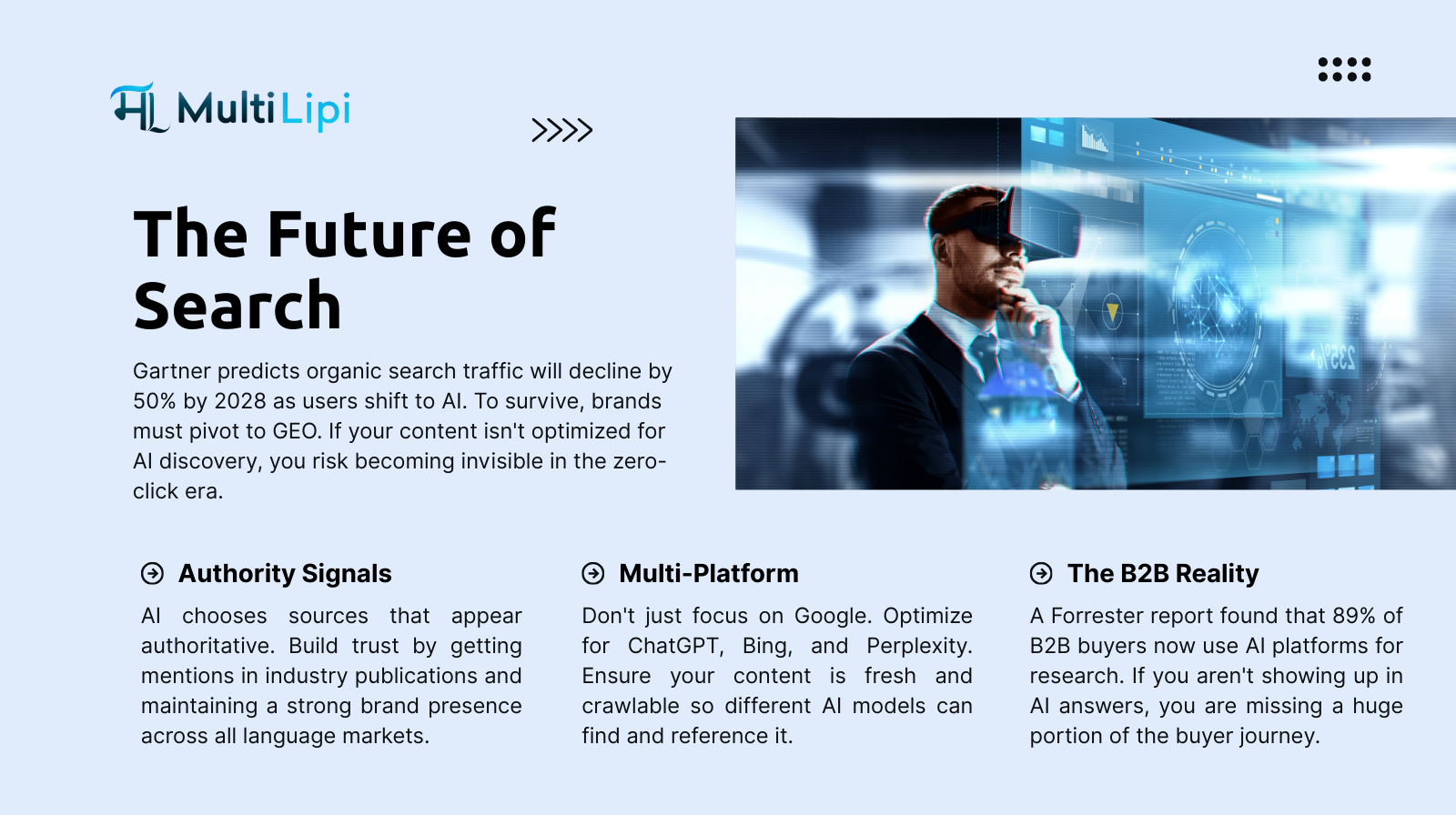
Let’s demystify this buzzword: Generative Engine Optimization (GEO) is the practice of optimizing your content specifically for AI-driven platforms – the answer engines – rather than just traditional search engines. In plain terms, GEO is about making your content quotable and citable by AI systems (ChatGPT, Google’s AI snapshots, Bing Chat, Amazon’s Alexa, you name it). Instead of fighting for the top spot on page one, you’re fighting to be the source that the AI references when it gives an answer.
How GEO differs from traditional SEO:
- Traditional SEO focuses on ranking a page so that a user clicks on it. Success is measured in clicks and site visits. You target keywords, build backlinks, and optimize technical factors to please Google’s algorithm (which then shows your link to the user).
- GEO, on the other hand, focuses on structuring and presenting information so that an AI can easily extract and trust it. Success is measured in citations and mentions within AI-generated answers. In a GEO scenario, the user might see your brand or a snippet of your content inside the AI’s answer, along with a citation link. The user may or may not click that link – but your information shaped their decision regardless. [Single Grain]
Think of it this way: With GEO, “you’re no longer trying to be at the top of page one; you’re trying to be part of the answer itself.” Your content needs to be so clear, authoritative, and relevant that the AI says, “Aha, this is a piece of the answer I’m composing.”
Key principles of GEO (Generative Engine Optimization):
- Answer-First content: Structure your content to lead with concise answers. For example, begin pages or sections with a direct summary or definition (much like a featured snippet) so AI can grab that as a quotable piece. If you have an article titled “What is Schema Markup?”, the first paragraph should straightforwardly explain what schema markup is in 1-2 sentences. (This doubles as good practice for users and voice search too.) By treating key concepts as entities and defining them clearly (e.g., What is Schema Markup? Schema markup is a structured data vocabulary that helps search engines understand the context of your content...), you make it easier for AI to parse and trust your content.
- Structured data and semantic HTML: Implement schema markup (FAQ, How-To, Article, etc.) and maintain a clean HTML structure (headings, lists, tables where appropriate). AI systems and search engines both appreciate content that’s well-structured. Pages with organized data are more likely to be used in Google’s AI overviews. For instance, having FAQ schema on your pages might directly get your Q&A picked up in an AI response on Google’s SGE.
- Authority and trust signals: Generative engines choose sources that appear authoritative and accurate. Building authority goes beyond just traditional Domain Authority. It includes being mentioned on sites the AI already trusts. It’s no accident that Wikipedia content is frequently cited by ChatGPT and Bing; Wikipedia has consistent, structured info. While not every company can get a Wikipedia page, you can strive for mentions in industry publications, maintain a strong brand presence, and even contribute to community Q&A (like relevant subreddits, Quora, etc.) where appropriate. In a multilingual context, this may mean getting citations or press in each target language market, not just your home market.
- Multi-platform optimization: GEO isn’t just about Google’s flavor of AI. Think broadly: ChatGPT, Bing (which uses GPT-4), Perplexity, Baidu’s Ernie, IBM Watson, and whatever Gemini will bring. Each might have slightly different ways of finding info. For example, Bing’s chat cites sources and can crawl real-time content; Google’s SGE favors fresh and well-structured content; ChatGPT (in its current form) relies on its training data and knowledge cut-off, but tools like Bing Chatou ChatGPT Browsing can fetch live content if prompted. The upshot is you should ensure crawlability and up-to-date content. Keep your content updated so that when these models refresh or when real-time crawling is in play, your information is current. Use proper meta tags (like lastmod in your sitemaps) so AI knows your page is fresh. Also consider platforms like YouTube (since AI might pull answers from transcripts/videos) – e.g., Google’s AI could show YouTube content in answers. GEO means covering your bases across content formats and platforms where answers might be drawn from. [MultiLipi - Cultural Code]
Now, you might be thinking: This is a lot to take in. Indeed, GEO is a new discipline on top of SEO. But ignoring it isn’t an option if your traffic is falling. As Gartner predicts, organic search traffic will decline 50% or more by 2028, with LLM-powered search handling over 50% of global queries by 2030. In other words, this AI/zero-click trend isn’t a blip – it’s the future. Brands that adapt early will capture outsized visibility, while others become invisible. A recent Forrester report even found that 89% of B2B buyers use AI platforms like ChatGPT for research, meaning if your brand isn’t showing up in AI-driven answers, you’re literally absent in a huge portion of the buyer journey
So let’s move from theory to practice. How do you actually optimize and defend your multilingual traffic in this new era? Below is a step-by-step strategic approach – turning our anxiety into expert education and finally into a confident solution for the AI era.
From Anxiety to Action: How to Reclaim Your Traffic in the AI Era
By now it’s clear that the rules of SEO have changed. But this isn’t a doom-and-gloom “SEO is dead” sermon. Rather, it’s a call to evolve. Here’s a comprehensive action plan to help CMOs, SEO managers, and founders not only stem the loss of traffic, but actually thrive in the zero-click, AI-first world. We’ll focus on multilingual GEO strategies – ensuring your content in every language has the best shot at being the answer AI provides. [MultiLipi - Ecommerce Guide]
1. Provide Direct Answers (and Make Them Easy to Snippet)
Lead with answers: Structure your content in an answer-first manner. This means anticipating the exact questions users (or AI) might ask and answering them clearly and immediately. For example, if you have a blog post on "How to Do Multilingual Keyword Research", start it with a concise definition or summary of the process before diving into details. This way, whether it’s Google’s featured snippet extractor or ChatGPT, the AI can easily grab that neat answer chunk. Use heading tags for questions (H2 or H3 for each FAQ-style question) and provide the answer right below. Not only does this help users scanning your content, it’s also perfect fodder for AI. In fact, Google’s own AI overview sources heavily feature FAQ and How-To content with schema, because it’s formatted in a way that’s convenient to repurpose in an answer.
Use schema markup: Implementing structured data is like adding a neon sign for AI: "Here’s exactly what this piece of content is about." If you have a product page in multiple languages, use Product schema with the name and description in each respective language. If you have how-to guides or FAQ pages, mark them up accordingly (and yes, translate the schema fields too!). Structured data in each language helps ensure the AI doesn’t mix up content or context when dealing with multilingual info. It also increases the chances of getting rich results in Google’s SERPs, which sometimes are what the AI overviews draw from. As an example, a FAQ in French marked up with FAQPage schema might be directly used by a French AI answer or even an English answer if the AI is collating multilingual sources. The bottom line is that clear structure = higher chance of being picked. (If you need a refresher on schema, see a primer on how to implement it for SEO benefits.)
Be explicit and unambiguous: Remember, AI isn’t a mind-reader; it relies on what’s in your content. So, be explicit with important facts and statements. If your brand won an award or is #1 in something, state it plainly (and back it up with a citation or source). If you’re giving a how-to step, list it as step 1, 2, 3, etc. The clearer and more extractable your content, the more likely an AI will include it. This is where simplified language and avoiding fluff helps. It’s tempting to be poetic in writing, but AI thrives on straightforward, fact-rich prose. Aim for a balance: authoritative yet human (because AI also models human-like responses). A pro tip is to monitor AI answers for your topic. Search some queries on Google’s SGE or ask ChatGPT a question from your domain – see whose content it’s citing or summarizing. If you notice competitors’ snippets showing up, analyze their format. Are they using bullet points? Do they define terms early? Let that inform your content layout.
2. Localize for Humans e Machines
If you run a multilingual site, you might already know the mantra “Don’t just translate – localize.” Now we add a twist: localize not only the visible content, but also the behind-the-scenes elements that search engines and AI parse.
Here’s a quick checklist for machine-friendly localization: - Hreflang and language tags: Ensure every localized page properly implements hreflang tags pointing to its alternatives (and a self-referential tag). This is non-negotiable – it’s how Google knows which language version to serve to whom. Without hreflang, your Spanish page might never be shown to a user in Mexico because Google doesn’t realize it’s the right match (or worse, Google might treat it as duplicate content of your English page). The correct hreflang setup also helps AI: Google’s index is the foundation for its AI answers, so if your page isn’t correctly indexed per locale, it won’t surface. (Our [Hreflang Tag Guide] breaks down implementation steps and common pitfalls if you need guidance.) - Translate the metadata and tags: It’s astonishing how often companies translate page content but leave things like the <title> tag, meta description, or image alt text in the original language. These elements are crucial for SEO and also contribute to how AI perceives the page. An AI might not “see” your images, but if it parses the alt text and finds it irrelevant (or in the wrong language), that’s a lost opportunity for context. Use a platform or workflow that ensures tudo – from Open Graph tags to schema properties like "headline": "...", "description": "..." – is translated or localized appropriately. Tools like MultiLipi automate a lot of this heavy lifting (e.g., generating localized meta tags and even translating URL slugs for you). Simply put, speak the machine’s language in each locale, not just the user’s. - Preserve your SEO on translated pages: A common myth (one we debunk in [5 Common Myths About Multilingual SEO]) is that translation alone equals multilingual SEO. In truth, you must carry over or adapt your SEO strategy for each language. That means keyword research in each language (users in Spain might search differently than users in Mexico or Argentina, even though they share Spanish – consider local slang and preferences). It also means checking the on-page SEO basics after translation: do your headings still contain the main keywords in that language? Did the translated version accidentally remove a keyword or change a meaning? Using an Analisador de SEO por IA tool (like MultiLipi’s [AI SEO Analyzer]) on your localized pages can flag if your H1 is missing or if the keyword density is off due to translation. For example, maybe your English page was well-optimized for “best project management software”, but your French translator chose a less common synonym for “project management” – that could hurt your French SEO. A quick audit will catch such issues. - Cultural and regional customization: This goes beyond pure SEO, but it’s worth stating: ensure your content is truly localized. If examples or case studies in your content all reference U.S. scenarios, consider adding local examples for other languages. AI models pick up on relevance and local context too. A German user asking an AI a question might get an answer that leans on German-specific references if available. If your German content includes local case studies or stats, the AI might favor it over a generic global piece. Local trust can matter – for instance, an AI might note that your .de domain content is meant for Germany (thanks to hreflang and localization) and thus use it for German queries. In short, speak to the local user’s context, not just their language.
By thoroughly localizing both content and metadata, you not only improve human UX (and conversions), but you also increase your chances of being the source AI chooses for that language. It’s about covering all bases: a multilingual site that’s technically sound, rich in local keywords, and relevant in context is primed for both SEO and GEO success. (If you haven’t yet, check out our [LINK: Beginner’s Guide to Website Localization] to ensure you’re not missing any aspect of adapting content beyond mere translation.)
3. Bolster Your Authority and Brand Signals (Especially in Every Language)
In the era of answer engines, authority is everything. Large Language Models don’t have a classic search algorithm with PageRank, but they do have training data and they do prefer citing well-known sources to maintain credibility in answers. Google’s SGE, for instance, cites high-authority websites, reputed news outlets, and content with schema or featured snippet status. ChatGPT’s training data shows a heavy bias towards sources like Wikipedia, educational sites, and forums like Reddit for certain info. So how can you make your brand and content more authoritative in the eyes of these systems?
Some strategies to build authority in the AI context: - Get your brand/entities into the knowledge graph: This might be a longer-term play, but having a Knowledge Panel or being recognized as an entity by Google can help. Ensure your organization’s schema (Organization markup) is on your site, including multilingual versions if applicable. Use sameAs links in schema to point to your official social media, Wikipedia page (if exists), Wikidata item, Crunchbase profile, etc. Essentially, create a digital paper trail that establishes your brand’s identity and legitimacy. AI systems ingest knowledge graphs and databases – if your brand is in those, you’re more likely to be mentioned. - Leverage multilingual PR and backlinks: High-quality backlinks have always been an SEO staple. For GEO, think of backlinks as not just link juice, but evidence of relevance. If authoritative sites in Spanish, French, and Japanese all reference your content, an AI will have “seen” your brand in those languages during training or crawling. That increases trust. Work on a PR strategy in each key locale: get featured in local industry publications, sponsor research or write guest posts that local sites might link to. Not only will this drive direct traffic, it feeds the AI more reasons to consider you credible when constructing answers. - Contribute to community and Q&A platforms: AIs like ChatGPT consume a lot of content from Q&A sites (StackExchange, Quora, Reddit threads, etc.). If there are common questions in your industry, have experts from your team answer them on public forums (using brand handles if appropriate). For example, if you’re a SaaS project management tool and you have a Spanish community manager, they might answer questions on a Spanish marketing forum or StackOverflow in Spanish. If those answers mention your product and are upvoted, not only do you get human eyes, but the next AI training cycle might incorporate that content. It’s a bit meta, but you are literally feeding the AI information about your expertise. Just be transparent and provide value, not spam – remember the AI will also detect if the community upvoted it or not. - Claim your space on Wikipedia and Wikidata: Wikipedia is heavily used by both Google (for its Knowledge Graph) and by LLMs. If your company or key product is notable enough, consider creating a Wikipedia page (abiding by their guidelines – it needs to be genuinely notable with third-party references). Also, ensure it’s translated into the major languages of your markets. Many companies have pages on English Wikipedia but forget to create, say, a Spanish or French version. If a user asks an AI in French about a topic and your French Wikipedia page exists, that could be a gold mine source for the AI to pull from. Even if you can’t get a full Wikipedia page, make sure you have a Wikidata entry (Wikidata is a structured database that underpins a lot of knowledge graphs). List all alternate names, the languages you operate in, etc., on Wikidata. It’s like SEO for knowledge graphs. - Show E-E-A-T on your site: Google talks about E-E-A-T (Experience, Expertise, Authoritativeness, Trustworthiness) even for AI content. Make sure your site (in each language) showcases real authors with bios, lists credentials, and has trustworthy signals (privacy policy, contact info, etc.). An AI picking up your content might not “see” those directly, but Google’s algorithms (which feed SGE) do. And if your content is being evaluated for a quality threshold to be cited, having those elements could tip the scales. For example, an AI might have multiple sources to choose from for an answer snippet – if one is a random blog and another is a site with clearly identified experts and sources, the AI might lean toward the latter (some research suggests AI is trained to value text that looks well-cited and authoritative).
The takeaway: Don’t neglect digital PR and branding in your SEO strategy. In a sense, SEO is now as much about who says it as what is said. In multilingual SEO, this means replicating that authority in each market. Your French site shouldn’t just be a translated afterthought of your English site – try to get local reviews, local case studies (maybe partner with a local client for a testimonial), and local endorsements. These not only help conversions but also create content cues for AI.
4. Monitor AI Visibility and Reframe Your KPIs
As we enter this new era, it’s crucial to change how we measure success. If you only measure traditional organic traffic and rankings, you might miss the bigger picture of how your content is performing in the AI landscape. Here’s how to adapt:
- Track AI mentions and citations: Start paying attention to whether and how your brand appears in AI-generated content. This could be as simple as manually asking ChatGPT and Bard some key questions and seeing if you’re mentioned. There are also emerging tools that track brand mentions in AI answers – for instance, some SEO suites are developing AI monitoring features that scan Google’s SGE snapshots or Bing Chat results for your URLs. If you’re using Bing Webmaster Tools, you might see incoming traffic from Bing’s chat (it shows as referral traffic). Similarly, analyze server logs or analytics for spikes in traffic from “GPT” or unusual user agents; sometimes you’ll catch AI scraping or citation ref hits. The goal is to build a baseline: e.g., “Our site is cited in 5% of AI answers about topic X; let’s raise that to 10%.” This is analogous to measuring search impression share or share of voice in traditional SEO.
- Keep an eye on zero-click metrics: In Google Search Console, monitor your Impressions vs Clicks. If impressions are steady or rising while clicks drop, that’s a sign of zero-click in action (people see you in search but not clicking – possibly because they got an answer already). Google’s introduction of SGE might not explicitly show up in GSC, but patterns like high impressions + low CTR on informational queries are a clue. By identifying which queries have this issue, you can prioritize those for GEO optimization (maybe those queries have featured snippets you can target, or you can create content that better addresses them so you become the zero-click answer).
- New KPI: AI Referral Traffic & Conversion Quality: If you do get cited by AI (like Bing Chat or even users copy-pasting from ChatGPT), track what those visitors do. Early evidence suggests that AI-referred visitors can be extremely engaged – one analysis found AI-driven visitors stayed 9+ minutes on sites on average and had an 85% return rate. Even if these volumes are small now, their conversion rates might be higher (they come pre-qualified by the AI’s recommendation). For example, if ChatGPT mentions your product as a top solution and the user clicks through, they likely have high intent. So measure things like lead conversion or sign-ups from these sources. It might turn out that even as raw traffic drops, the value of each visitor goes up – which changes how you allocate marketing resources. This aligns with what some are calling the “quality-over-volume” reframe: fewer clicks, but from users who are further along the decision process (because the AI did some vetting for them).
- Educate your stakeholders with these metrics: Your team or your boss might currently be freaking out about the traffic decline. Part of your role is to reframe the narrative. Introduce these new metrics in your reporting. For instance, report on how many times your content was served in AI answers (even if no click). If you can show that while overall sessions dropped 20%, the pipeline or revenue stayed steady or even improved from organic channels, that’s significant. It means you’re reaching users in new ways. Also, track how GEO efforts correlate with changes. If after implementing FAQ schema and restructuring an article, you start seeing it appear in SGE snapshots, highlight that! It’s a win in the new world.
A good internal linking here: you might point to our [LINK: SEO vs GEO Dashboard Guide] if we had one, but since we have placeholders, we’ll just stress the concept. The main point is to evolve KPIs from pure traffic to a more nuanced set that captures AI influence.
5. Leverage Tools and Automation to Scale GEO for Multilingual Content
Adapting to all of this might seem overwhelming – especially if you manage a large multilingual site. This is where the right tools and platforms can be a lifesaver. As the Head of Content Strategy at MultiLipi, I’d be remiss not to mention how we’re evolving our platform specifically for this challenge (yes, a bit of a shameless plug, but it’s directly relevant!).
MultiLipi’s approach to “Multilingual GEO”: We started as a multilingual SEO and translation platform, but we’re rapidly adding features to help with Generative Engine Optimization. For example: - AI-optimized translations: Our system not only translates content but now offers Sugestões de Conteúdo com IA [MultiLipi 2.0: New Features] that ensure your phrasing is locally natural e optimized for clarity. If a sentence in English is too convoluted or doesn’t translate cleanly, the AI suggests a rewrite that might be simpler and clearer, which, as we discussed, is better for AI consumption. - Technical SEO health at scale: Features like the AI SEO Vulnerability Detector scan your site for issues like missing tags or performance problems across all languages. This is crucial because a slow or broken page in any language won’t get crawled often, and thus won’t be there for AI to find. Our tool even gives fix suggestions, which cuts down the time to optimize hundreds of pages significantly. - Automating hreflang and sitemaps: MultiLipi automatically generates hreflang tags and updates sitemaps for your translations. This is boring but important – one less thing for you to worry about, and it guarantees that Google receives the correct signals for indexing. When Google’s index is right, the AI answers derived from it will also be right (and will include your pages where they should). - Consistent multilingual metadata: We use translation memory and glossaries to maintain consistency for important terms (like your product names or industry terms). This means your Spanish pages will consistently use the same phrasing the AI might have seen in training, increasing the chance it recognizes and trusts that content. Inconsistent terminology can confuse AI (and users). For instance, if one page says “e-commerce” and another says “online retail” in the same language, an AI might not link them together as easily. Consistency = clarity. - Monitoring and analytics integration: We’re working on features to integrate with analytics and possibly track AI referral traffic (e.g., visits from Bing Chat). While that’s still nascent, being on a platform that’s thinking ahead about GEO means you’ll be ready as more data becomes available.
If you’re not using a dedicated platform, at least consider automating where possible. Use plugins or scripts for hreflang management, use SEO audit tools that check each language site, and consider content optimization tools that are AI-aware (some newer SEO tools now have “AI analysis” of content to predict how an AI might interpret it). The goal is to reduce manual workload so you can focus on strategy and content quality.
Internal collaboration: Also, ensure your SEO, content, and localization teams are in sync. GEO is multidisciplinary – it involves technical SEO, content strategy, and even PR. For example, when planning content, think: Can we create a piece so authoritative that others will cite it? Can we produce a multilingual research report that becomes a go-to source in our industry (and thus AI will reference it)? Those kinds of big rock content pieces can pay off massively in an AI-driven world.
6. Embrace the Change: Experiment, Learn, and Iterate
This last point is more of a mindset shift. The era of AI-driven search is still unfolding. We’re all learning as we go – even Google and OpenAI are iterating rapidly. To succeed, you need to foster a culture of experimentation and agility in your SEO and content efforts.
- Pilot new content formats: Try creating a high-level summary page for a topic alongside a deep-dive page. See if the summary (answer-focused) gets picked up by AI or featured snippets, while the deep-dive can capture the long-tail clicks. Experiment with putting a “Quick Answer” box at the top of pages (essentially a self-contained snippet). You can even A/B test content layout and see if it affects snippet or SGE pickup (though measuring that is tricky, you might infer from CTR changes).
- Monitor industry developments: Follow sources like Google Search Central blogs, Search Engine Land, and SEO Twitter (or X) for the latest on how AI is affecting search. For instance, if Google releases an update to how SGE cites sources, that’s something you want to know ASAP. (One recent example: Google started bolding why it cited a source in SGE – e.g., “cited for its definition of X”. That implies if you want to be cited, have a clear definition of X. Little insights like that can guide your content tweaks.)
- Educate and align your team: Make sure everyone – from writers to execs – understands this shift. It might be worth doing a knowledge-share session where you demonstrate a search in the new SGE vs old Google, or how ChatGPT answers a question with versus without a certain source. When the team gets it, they’ll write and optimize with this in mind naturally. For example, writers will know to phrase key points clearly and maybe even preemptively answer common questions in the text because they realize an AI might take just that part to display to a user.
- Stay user-centric, as always: One reassuring thing in all of this is that what’s good for AI answers tends to be good for users too. Clear, concise answers up front? Users love that. Well-structured content with headings and lists? Great for readability. Authoritative, well-researched content? Users trust that as well. So by pursuing GEO, you’re not abandoning the user – you’re actually doubling down on quality and clarity. Google’s algorithms (and AI) are essentially trying to reward content that best serves user needs, just in a different presentation. So if you keep user intent and benefit as your North Star, you’ll naturally create the kind of content AI wants to show.
Finally, don’t panic. Yes, the game has changed – dramatically. But remember: when SEO shifted to mobile-first or when featured snippets first appeared, many in our field sounded the alarm that SEO was “dead.” It wasn’t; it evolved. The same is happening now. We’re in the Answer Engine Optimization era. Fewer clicks doesn’t mean less impact if you adapt. You might get zero-click impressions that influence a customer who never visited you – maybe they went straight to calling your sales team after an AI recommended you. That’s still a win, even if it’s not a traditional web visit.
By implementing the steps above – from technical tweaks to content strategy pivots – you can transform that anxiety into confident execution. Companies that act now to optimize for generative AI and multilingual zero-click searches will capture attention and trust that others are losing.
Conclusion: Thriving in the Zero-Click Era
The rise of AI chatbots and zero-click searches is a disruptive force, but it doesn’t spell doom for those willing to adapt. Think of it as the next chapter in search marketing’s evolution. The game has changed, but the game is not over.
Key takeaways to remember:
- You’re not imagining things – your traffic really may be dropping even though your SEO efforts haven’t faltered. It’s a structural shift: users are getting answers from AI platforms and enriched search results, leading to fewer clicks. Over 65% of searches might soon be zero-click[1], and organic CTRs are hitting record lows[2]. This is the new normal.
- Multilingual sites face extra hurdles because AI can translate and cherry-pick information across languages. If you haven’t optimized your multilingual content for machine consumption (via hreflang, structured data, etc.), you’re at risk of being bypassed. Conversely, a robust multilingual GEO strategy can turn this into your advantage – many sites will fail to do this properly, giving you a chance to leapfrog competitors in non-English markets by becoming the trusted answer source in those languages.
- Generative Engine Optimization is your playbook forward. By focusing on clear answers, structured data, authority building, and user-centric content, you reposition your site from being just “one of ten blue links” to being the source that powers AI-driven answers. In a sense, you own the answer, not just the ranking.
- Adapt your metrics and mindset. In the zero-click era, success might mean getting cited even when you don’t get clicked, and seeing higher conversion rates from lower traffic. Educate your stakeholders that traditional traffic is not the sole measure of SEO success anymore – visibility in AI and influence on the customer journey can happen without a click. We’re all learning how to quantify this, but it’s important to start now.
- Double down on quality and relevance. With AI, there’s no tricking your way to the top. If anything, the algorithms are getting better at picking up genuine expertise and usefulness. High-quality multilingual content, properly localized and technically optimized, will stand out. The quick hacks of yesteryear (keyword stuffing, PBN links, etc.) have even less place now. Focus on what really makes your content the best answer.
As we move from constructive anxiety to confident solution, remember that every wave of change in search has created new winners. By reading this far, you’re already ahead of many, arming yourself with knowledge to turn this challenge into an opportunity.
The zero-click era is here to stay, but with a proactive GEO strategy, you can ensure your brand remains front-and-center in the conversations that matter – whether they happen on a search results page, in a chat window, or spoken by a virtual assistant.
Now is the time to act. Adjust your strategies, implement the recommendations above, and watch how you can capture traffic (and customers) you didn’t even realize you were missing. The game has changed – and now, equipped with the right insights, you have the playbook to change with it and win.
✨ Comece hoje a sua jornada multilíngue.
Traduz, otimize e escale com a MultiLipi a forma inteligente de se tornar global.
Pronto para ver isso em ação?
Let us show you exactly how MultiLipi can transform your website. Schedule a personalized, 1-on-1 demo with our team today.
[Agende a Sua Demonstração Gratuita ]
Comentários